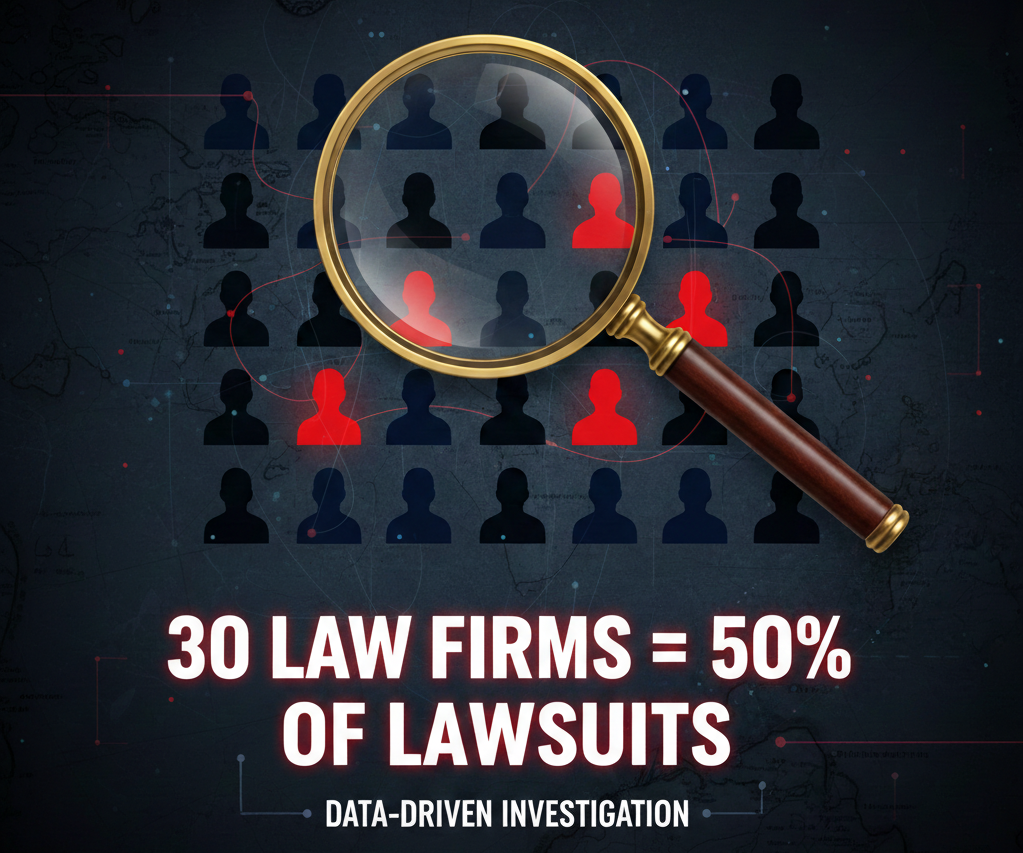
Over 5,000 ADA digital accessibility lawsuits were filed in 2025. We analyzed court filings from CourtListener's RECAP archive and cross-referenced published reports from EcomBack and UsableNet to answer a question most businesses don't ask until they're served: who is actually suing?
The answer reveals a remarkably concentrated industry.
The Numbers: 188 Plaintiffs, 5,000+ Lawsuits
In the first half of 2025, just 188 unique plaintiffs filed 2,014 ADA website accessibility lawsuits in U.S. federal courts. That's an average of 10.7 lawsuits per person over six months.
But the concentration is far more extreme than that average suggests:
| Metric | Count | % of Total |
|---|---|---|
| Top 5 plaintiffs | 343 cases | 17.03% |
| Top 10 plaintiffs | 537 cases | 26.66% |
| Top 31 plaintiffs | 1,016 cases | 50.45% |
| Remaining 157 plaintiffs | 998 cases | 49.55% |
Half of all lawsuits came from just 31 people.
The Top 10 Plaintiffs
Here are the individuals who filed the most ADA website accessibility lawsuits in the first half of 2025, based on EcomBack's analysis of federal court filings:
| Rank | Plaintiff | Law Firm | Cases (H1 2025) | % of Total |
|---|---|---|---|---|
| 1 | Michael Sandoval | Manning Law, APC | 114 | 5.66% |
| 2 | Julie Dalton | Throndset Michenfelder Law Office | 74 | 3.67% |
| 3 | Perla Mageno | Manning Law, APC | 55 | 2.73% |
| 4 | Rebecca Castillo | Manning Law, APC | 52 | 2.58% |
| 5 | Robert Glen Myers | ADA Legal Team, LLC | 48 | 2.38% |
| 6 | Victor Ariza | Roderick V. Hannah, Esq., P.A. | 44 | 2.18% |
| 7 | Nicholas Pagan | Alberto R. Leal, Esq., P.A. | 42 | 2.09% |
| 8 | Oscar Herrera | Roderick V. Hannah, Esq., P.A. | 37 | 1.84% |
| 9 | Yudy Hernandez | Adams & Associates, P.A. | 36 | 1.79% |
| 10 | Abdurazak Abdu | Equal Access Law Group, PLLC | 35 | 1.74% |
Source: EcomBack 2025 Mid-Year Report
Michael Sandoval alone filed 114 lawsuits in six months — that's roughly one lawsuit every business day, plus Saturdays. We verified his filings on CourtListener and found cases in the Central District of California against defendants ranging from Don Roberto Jewelers to Ace Hardware Corporation, all represented by Manning Law, APC.
The Law Firms: 16 Firms Control 90% of Cases
The plaintiff side of ADA website litigation is dominated by a small number of specialized law firms. In H1 2025, just 16 firms filed over 90% of all lawsuits:
| Rank | Law Firm | Cases | % of Total |
|---|---|---|---|
| 1 | Manning Law, APC | 287 | 14.25% |
| 2 | Gottlieb & Associates | 265 | 13.16% |
| 3 | Equal Access Law Group, PLLC | 248 | 12.31% |
| 4 | Stein Saks, PLLC | 211 | 10.48% |
| 5 | Roderick V. Hannah, Esq., P.A. | 137 | 6.80% |
| 6 | NYE Stirling, Hale & Miller, LLP | 99 | 4.92% |
| 7 | Aleksandra Kravets, Esq. P.A. | 89 | 4.42% |
| 8 | Throndset Michenfelder Law Office | 84 | 4.17% |
| 9 | AJG Law Group, PC | 72 | 3.57% |
| 10 | Asher Cohen PLLC | 67 | 3.33% |
The top 5 firms alone account for 57% of all filings. The total number of active firms? Just 30.
Source: EcomBack 2025 Mid-Year Report
Firm Profiles From Our CourtListener Analysis
Gottlieb & Associates (New York) — We found this firm on CourtListener representing plaintiffs like Emanuel Delacruz, Joseph Ortiz, Denise Crumwell, Henry Tucker, and Sylinia Jackson across dozens of S.D.N.Y. cases. In Q1 2025, the firm led all firms with 156 lawsuits (15.87%). Their attorneys Jeffrey M. Gottlieb and Michael A. LaBollita appear on hundreds of dockets. In 2024, the firm filed 190 federal ADA Title III lawsuits. (Source: ADA Title III Blog)
Manning Law, APC (California) — The firm represents the three highest-volume individual plaintiffs (Sandoval, Mageno, Castillo). On CourtListener, we found Manning Law filings in the Central District of California targeting retailers, restaurants, and consumer brands. Their 287 H1 2025 cases represent the highest firm-level volume in the country.
Equal Access Law Group, PLLC — Operating across multiple jurisdictions with 248 cases. Their plaintiffs include Abdurazak Abdu (35 cases) and others filing primarily in Illinois and New York.
Where These Lawsuits Are Filed
Geography matters. Certain jurisdictions have historically been friendlier to accessibility plaintiffs, and filing patterns reflect this:
| State | H1 2025 Cases | % of Total | YoY Change |
|---|---|---|---|
| New York | 637 | 31.63% | Down from 762 (−16.4%) |
| Florida | 487 | 24.18% | Up from 265 (+83.8%) |
| California | 380 | 18.87% | Up from 255 (+49.0%) |
| Illinois | 237 | 11.77% | Up from 28 (+746%) |
| Minnesota | 84 | 4.17% | Up from 48 (+75.0%) |
| Missouri | 48 | 2.38% | Up from 0 (new) |
| Pennsylvania | 47 | 2.33% | Down from 82 (−42.7%) |
| All Others | 94 | 4.67% | Up from 27 |
Source: EcomBack 2025 Mid-Year Report
The Illinois surge is the most dramatic story: from 28 cases in H1 2024 to 237 in H1 2025 — a 746% increase. This appears driven by new plaintiff-firm networks establishing operations in the Northern District of Illinois. On CourtListener, we found multiple plaintiffs (Smith, Tompkins, Booker, Fiallo) filing through the N.D. Illinois with cases against companies ranging from Dr. Martens to Nature's Sunshine Products.
New York: Serial Filers vs. Skeptical Judges
The New York decline is partly explained by federal judges pushing back on serial filers. Two rulings in May 2025 are significant:
Fernandez v. Buffalo Jackson Trading Co. — U.S. District Judge John P. Cronan stated that "Article III standing is not merely a pleading hurdle" but rather "a core constitutional guardrail." The court questioned how a plaintiff claiming a website was "largely inaccessible" could nevertheless navigate it thoroughly enough to catalog specific errors. The judge ordered jurisdictional discovery including the plaintiff's deposition and a forensic examination of his device. (Source: ADA Title III Blog)
Black v. 3 Times 90, Inc. — Judge Natasha Merle dismissed for lack of standing, noting in a footnote that the plaintiff had filed 27 lawsuits in the previous year. The court found the amended complaint failed to create a plausible inference that the plaintiff intended to return to the website.
The result: plaintiff firms are shifting from federal to state courts in New York, where standing requirements are less rigorous. Federal filings in New York dropped 39% since 2022, even as state court filings increased.
The Business Model
These lawsuits follow a standardized template. We analyzed complaint language across multiple CourtListener filings and found near-identical boilerplate:
"Defendant's website is not accessible to blind and visually impaired customers and, thus, violates Title III of the Americans with Disabilities Act (ADA), 42 U.S.C. §12181 et seq."
This exact language (or close variants) appeared in the vast majority of the 1,618 CourtListener results we examined for 2025 filings.
The economic incentive is straightforward. Plaintiff attorneys recover fees regardless of the settlement outcome for their client. A firm filing 250+ cases per year, with most settling for $5,000–$20,000 in attorney's fees per case, generates significant revenue. The firms don't need to go to trial. The cost of fighting exceeds the cost of settling, so businesses settle. The cycle repeats. For how much these lawsuits actually cost businesses, see our cost breakdown analysis.
Who Gets Targeted
Not everyone faces equal risk. Analysis of 2025 data shows clear targeting patterns:
By industry:
| Industry | % of Lawsuits |
|---|---|
| Restaurant, Food & Beverages | 30.49% |
| Fashion, Clothing & Apparel | 28.80% |
| Beauty, Skin & Body Care | 8.89% |
| Medical & Health | 7.15% |
| Furniture, Home Decor & Kitchen | 5.26% |
By company size:
- 36% of defendants had annual revenue exceeding $25 million (up from 33% in 2024)
- 35.8% of the top 500 e-commerce retailers received at least one lawsuit
By prior history:
- 1,427 cases (45% of federal filings) targeted companies that had already been sued before
A New Wrinkle: AI-Generated Lawsuits
According to Seyfarth Shaw, federal pro se ADA Title III lawsuits (filed without an attorney) increased 40% in 2025 compared to 2024. The likely catalyst: AI tools like ChatGPT, Copilot, and Gemini are making it trivial to draft legal complaints. Individuals who previously couldn't afford an attorney can now generate a serviceable ADA complaint in minutes.
This trend could fundamentally change the economics. Serial plaintiff firms have dominated because they controlled the infrastructure. AI democratizes complaint generation, potentially multiplying the number of filers.
What This Means For Your Business
The concentration of plaintiffs and firms does not make these lawsuits less valid or less costly. If your website has accessibility barriers, you can be sued — and the complaint will be legally sufficient regardless of whether the plaintiff filed one lawsuit that year or one hundred.
The practical takeaway: 16 law firms are actively looking for targets. They use automated scanning tools to identify websites with accessibility barriers, match them with plaintiffs, and generate complaints at scale. If your website has detectable WCAG violations (and 94.8% of the top million websites do), you are a potential target.
The most effective defense is not a legal strategy. It's making your website accessible. Tools like Woffy fix accessibility issues directly in your WordPress or Shopify source code — no overlays, no widgets, no six-figure consulting engagements. Run a free scan to see where your site stands.
Sources: EcomBack 2025 Mid-Year ADA Lawsuit Report, UsableNet 2025 Midyear Report, ADA Title III Blog, CourtListener RECAP Archive, WebAIM Million 2025