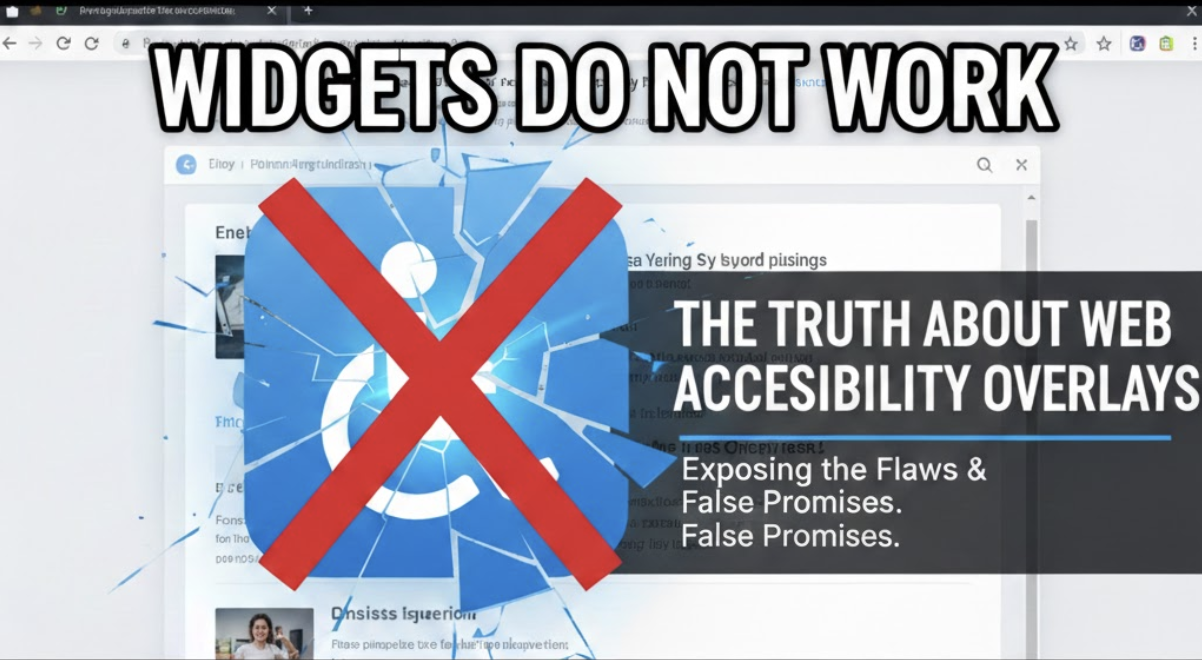
Small-business owners are being told that a single line of JavaScript—an "accessibility widget" or "overlay"—will make a website ADA-compliant and lawsuit-proof.
Peer-reviewed research, federal enforcement records, and more than 800 recent court filings show the opposite: overlays do not measurably improve accessibility, are explicitly rejected by judges, and are now a litigation magnet.
Why Owners Think Widgets Work
Vendors such as accessiBe, UserWay, and EqualWeb promise "1-click ADA compliance" for $49–$99 per month. Their pitch is simple: drop in a script, display a "seizure-safe" or "blind user" button, and avoid costly lawsuits.
The marketing is effective: overlay usage grew 250% between 2020 and 2023. The legal outcomes, however, contradict the claim.
Evidence That Overlays Do Not Improve Accessibility
Expert Consensus
The Overlay Fact Sheet, an open letter launched in 2020, has been signed by 1,060 accessibility professionals, including 21 former members of the W3C Accessibility Guidelines Working Group. The letter states:
"We will never advocate, recommend, or integrate an overlay which deceptively markets itself as providing automated compliance with laws or standards"
National Federation of the Blind
In a 2021 formal resolution, the NFB (representing ~50,000 blind Americans) condemned overlay providers for their "misleading, unproven, and unethical claims", and urged members to refuse vendor contracts that include overlay scripts.
Evidence That Overlays Do Not Reduce Lawsuit Risk
According to public records, there were 800+ ADA lawsuits in 2023-24 in which the defendant's website had an overlay from accessiBe or UserWay.
The fines keep coming, the docket numbers keep piling up, and the emails from frightened store-owners keep landing in my inbox: "I bought the little accessibility button. Why am I still being sued?"
Because the button was never the solution. It was the bait.
Start with the government's own hammer. In February 2024 the Federal Trade Commission announced that accessiBe (perhaps the most heavily advertised overlay on the planet) would pay a $1 million penalty and send corrective notices to every customer. The FTC was clear: competent and reliable evidence does not support the claim that the widget achieves WCAG 2.2 AA compliance.
Courts have been even blunter. When U.S. Wings, a mom-and-pop military-gear site, tried to dismiss an ADA case by pointing to its accessiBe badge, the Southern District of New York refused: "The Court concludes that defendant has not shown that it has undoubtedly fixed accessibility issues." The case settled four months later, after attorney hours, expert invoices, and a confidentiality clause.
In Pennsylvania, Eyebobs eyewear similarly faced a settlement agreement which forced them to rip the overlay out, hire an accessibility consultant, and submit to two years of outside audits. There are several more cases proving this, and in each instance the judge's message was identical: a decorative toolbar is not structural repair, and we are not fooled.
Why Do the Gadgets Fail So Predictably?
Because they work by injection, not by correction.
After your page loads, the script rewrites the DOM in real time, duplicating controls, scrambling focus order, and colliding with the screen-reader buffer the shopper already has running. The shopper hears two sets of landmarks, two "font-size" buttons, two color-contrast sliders: one built into the browser, one pasted on by a third-party server halfway around the world.
Performance audits show an extra 180 KB of JavaScript and almost a full second of mobile delay. Google clocks the slowdown, shoppers bounce, and the legal exposure remains exactly where it was: at the unlabeled form field, the empty alt attribute, the garbled heading hierarchy that the overlay never actually touched.
The Solution: Native Code Remediation
There is, finally, a way off the merry-go-round.
Woffy does the opposite of an overlay: instead of layering a toolbar on top of broken code, it filters the code before it ever leaves your server. Activate the plugin, and every post, product page, and checkout form is run through fifty WCAG 2.2 AA rules: alt-text inferred by computer-vision models, color-contrast math recalculated on the fly, ARIA landmarks injected where the theme forgot them, keyboard focus locked into logical order.
The cleaned markup is what the browser (and the screen reader) receives. No external call, no floating button, no 180 KB payload.
The Bottom Line
The choice is no longer between "cheap widget" and "expensive custom rebuild." It is between a toolbar that courts mock and a plugin that actually edits your code while you sleep.
For the latest data on specific overlay vendors, see our in-depth investigations: AccessiBe: 456 lawsuits and a $1M FTC fine and UserWay: The BloomsyBox class action.